Find the interruption
Repeated gold ornament gives your eye a rhythm. A red ruby, a pale diamond or a gap in the pattern becomes a natural stopping point. Find it before reading the caption.
Looking through contrast ↗ KELOVASHIA treasury atlas
Six intricate plates. A treasury of small discoveries. Find your own way through crowns, gemstones and golden curiosities.
Unfold the atlas VOLUME 01 AU EDITION / 2026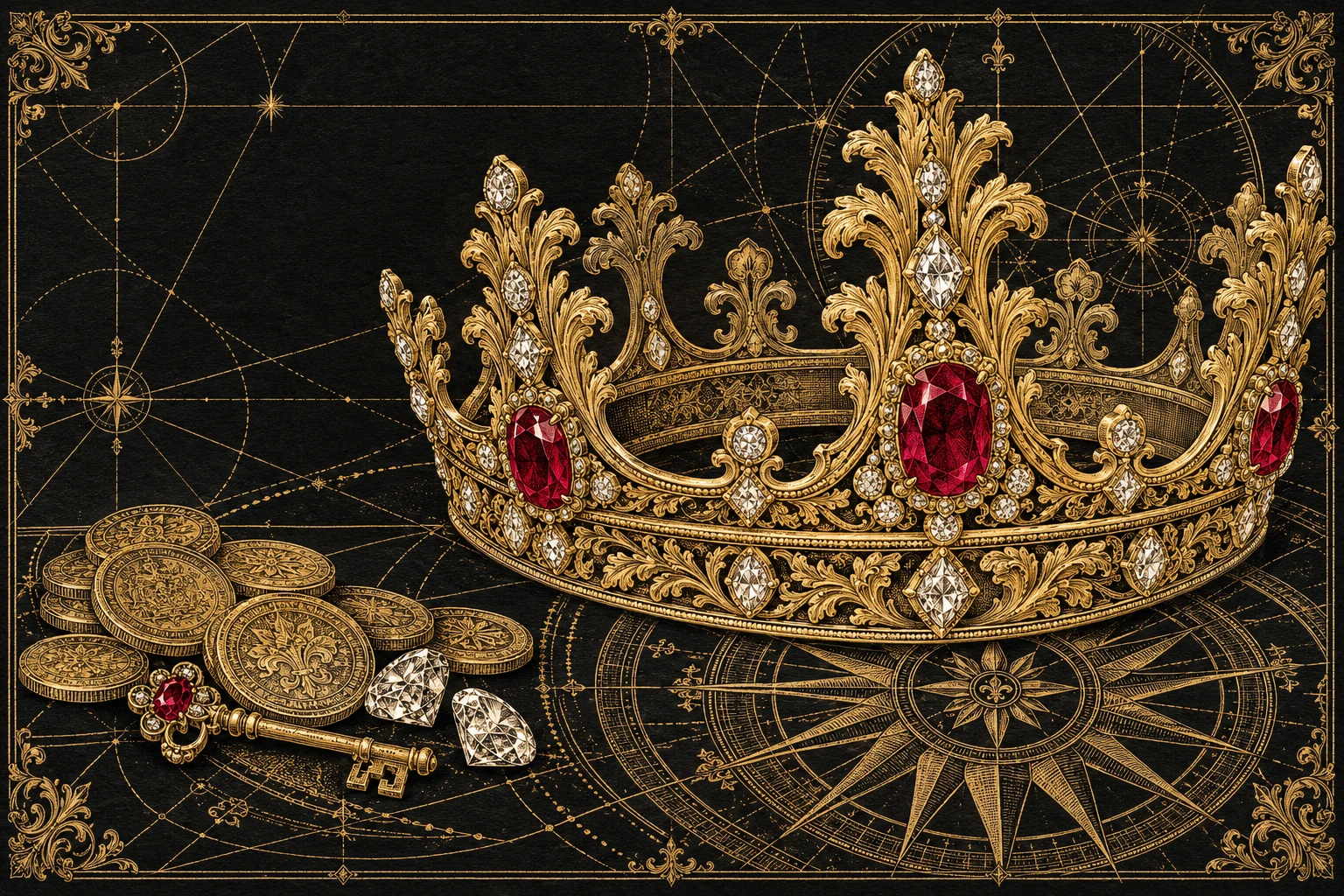
This one follows the language of treasure: the curve of a crown, the cut of a ruby, the rhythm of a hundred coins. Each fictional plate is an invitation to slow down, notice a detail and choose what to explore next.
The casket is a study in contrast. Dense ornament gathers around a single red centre; a loose chain breaks the precision of its borders. Start with the whole, then follow one detail until it leads you somewhere new.
Read the casket field note ↗“Look first for the thing that interrupts the pattern.”A looking prompt from the atlas
At C2, a bright diamond meets the exact geometry of a pair of dividers. Two different kinds of precision share the same plate.
Coordinates lead to treasures, rather than places. Select a marker to read the plate and its suggested route cost.
Begin at the widest band of the crown. Follow the small diamond settings into the rising acanthus leaves, then return to the red stones. The compass is a device for looking, rather than a claim about a real location.
3 travel units
Open this plate ↗Choose the plates that catch your eye. The planner adds their fictional travel units and helps you keep a route within a chosen limit. Nothing is booked or charged.
Select a treasury plate to begin your route.
8 units available.
The download is a text file saved to your device.Six compartments can hold six different stories. The Treasury Index asks you to compare scale, repetition and empty space — the quiet tools that make a busy collection legible.
01 / GROUPStart with the compartments. Notice which shapes share a space and which are kept apart.
02 / COMPAREFind the smallest object. Does it need more room or less ornament to hold your attention?
03 / CONNECTFollow a repeated curve from a chain to a ring to a coin. A collection has its own grammar.
The Ruby Meridian gives the atlas a vertical rhythm: one link, then another, towards a single pendant.
The surrounding fine arcs are not measurements of a real artefact. They are visual guides, borrowed from cartography to show how an eye travels through a composition. Compare the strict centre line with the small, uneven cluster of coins below.
Follow the meridian ↗Repeated circles become a flowing line. Follow the coins from vessel to key, then read the plate backwards. The objects stay the same; the story changes with your direction.
Repeated gold ornament gives your eye a rhythm. A red ruby, a pale diamond or a gap in the pattern becomes a natural stopping point. Find it before reading the caption.
Looking through contrast ↗A necklace, a chain and a stream of coins each create a route. Try drawing that route in the air. Where does the image ask you to begin, and where does it let you rest?
Following visual routes ↗Step back to see the whole plate, then enlarge one tiny area. Fine hatching builds shadows from lines; a clear silhouette keeps those details from becoming noise.
Reading the fine detail ↗No. The plates are original imagined artworks. They do not document historical artefacts or real locations. Kelovashi is a free creative browsing and planning experience.
Units are fictional weights that make the route-planning activity useful. They are not minutes, kilometres, prices or tickets. A route can be as short or as full as you like.
Route selections remain in the current page. You can download a text copy yourself. We do not receive the route, and there is no account or automatic synchronisation.
Yes. The pages respect your device’s reduced-motion setting. The storage choices panel also offers a page-level preference. All writing and plates are available without motion.
Share a reading of a plate, report an accessibility problem or ask a question about the atlas.
Write to Kelovashi ↗